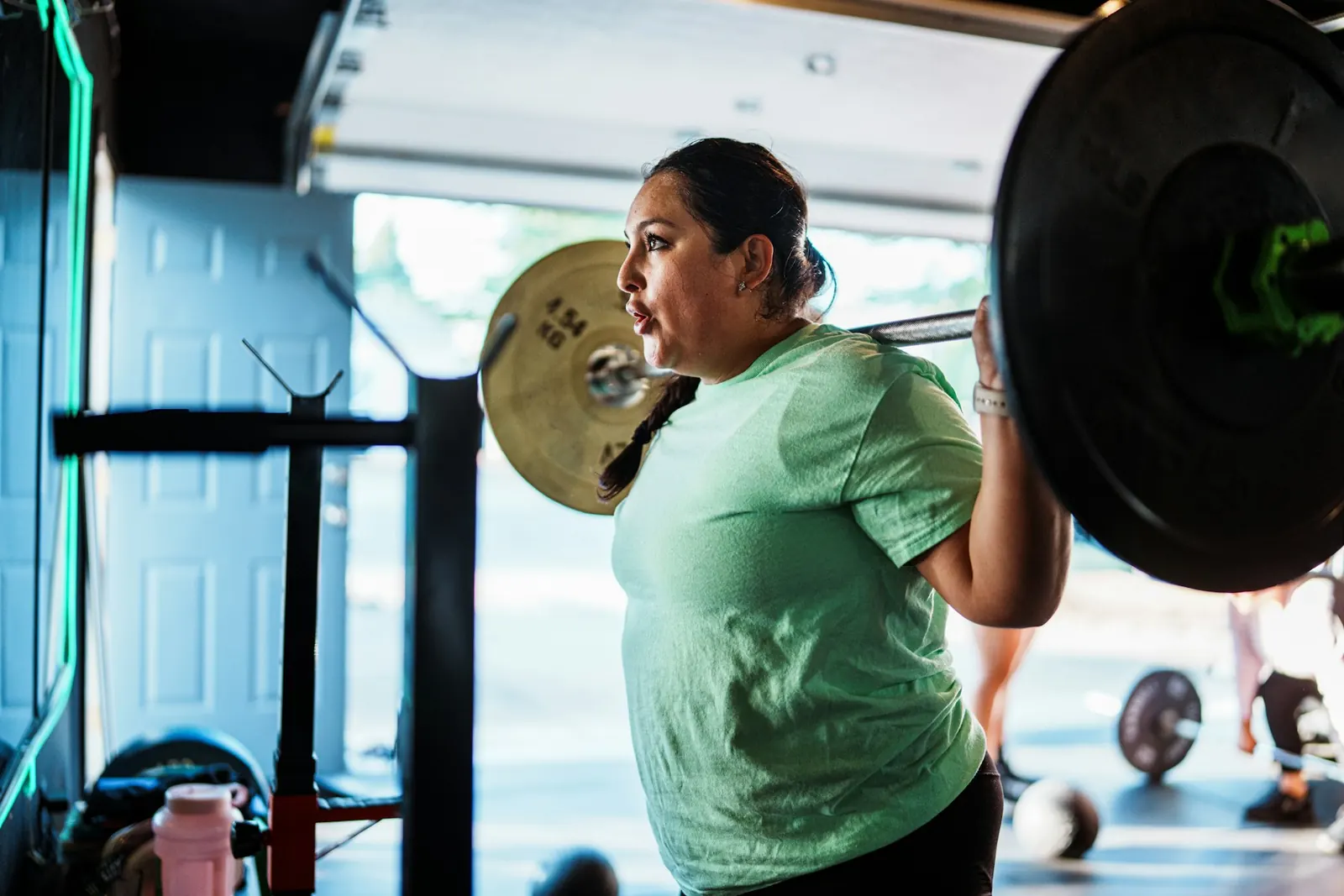
“I look the same, but I feel weaker.” You’re not imagining it.
Lots of women say some version of this in their 40s, usually while carrying groceries up the stairs. Nothing looks different, but everything feels heavier.
There’s a reason. In studies that measured both muscle and strength in the same people, strength faded 2 to 5 times faster than muscle.2 So your mirror isn’t lying. It’s just measuring the wrong thing.

What changes, and when?
It starts earlier and goes slower than most of us think. An MRI study of 468 adults found that muscle, as a share of body weight, starts slipping in the 20s and 30s. A clear drop in actual muscle didn’t show up until the late 40s, mostly in the legs.1
Menopause adds its own small layer. In a large US study, muscle started slipping about 0.2% a year, and fat gain sped up, but overall weight gain didn’t.3 That’s how the scale can say nothing’s happening while your jeans say otherwise.
A Finnish study of women aged 47 to 55 found a small muscle loss tied to menopause, and active women kept more of their muscle.4 Losing estrogen seems to affect both how much muscle you have and how much force it makes, though much of that idea comes from animal studies.5
What about hormone therapy? An older review found women on it were about 5% stronger.6 But the Menopause Society says newer reviews found it neither helped nor hurt muscle size, and that women will probably need other ways to keep their muscle.7
Which brings us, as these things always do, to the weights.
What creatine adds when you train
The biggest summary combined 22 studies with 721 men and women aged 57 to 70, all doing strength training two to three days a week. Compared with training plus a dummy powder, creatine added about 1.37 kg (3 lb) of muscle and a little extra strength.9 In women after menopause, a 2026 review found a smaller extra gain: about 0.37 kg (0.8 lb) of muscle, and 7.5 kg (16.5 lb) more on the leg press.18
What does that look like in real life? In one study, older women lifted three days a week for 12 weeks. Those on 5 g of creatine a day got stronger on bench press, leg extensions and biceps curls, and got better at standing up from a chair and from the floor. Their weight and body fat stayed the same.11 In another, frail older women trained twice a week, and creatine plus training built arm and leg muscle that training alone didn’t.10
One honest note: a body scan counts water as muscle, and creatine pulls water into your muscles. So part of that gain is water in the right place, not all brand-new muscle.
And without training? Nothing.
This is the part we’d put on the label, if we made labels. Two long studies gave women past menopause creatine with no exercise plan: 3 g a day for two years, and 1 g a day for one year. No change in muscle, bone, or getting up from a chair.1923
Creatine is a great passenger. It just can't drive.
The driving part doesn’t need a fancy gym. US guidelines ask adults to do muscle-strengthening activity, “like lifting weights or doing push-ups,” at least two days a week.21 That’s the same range most creatine studies used.
Will it help with everyday strength and falls?
With some everyday tests, yes. In a small review of adults aged 57 to 69 who lifted, creatine helped more with standing up from a chair: 23% better, versus 16% on the dummy powder. A timed walking test didn’t improve any more.14 Women on creatine in a 2-year study walked a little faster,13 and in a 1-year study, creatine plus training made lower-leg muscle denser.12
Better at standing up from a chair
Adults aged 57 to 69 who lifted weights
Source14
Fewer falls, though? Not shown. That 2-year study counted 30 falls on creatine and 19 on the dummy powder, a gap too small to count as a real difference, with 4 fractures in each group.13

Food, protein and a surprising number
Creatine comes mostly from meat and fish, and many people get very little. In US adults over 65, about 7 in 10 got less than 1 g a day from food, and about 1 in 5 got none at all on the day they were asked.20 We couldn’t find the same numbers for women in their 40s.
Protein matters too. An expert group recommends at least 1.0 to 1.2 g of protein per kg of body weight a day for adults over 65 (about 0.45 to 0.55 g per pound), and at least 1.2 g per kg for active ones.8 There’s no agreed number for women 40 to 55 yet, which is its own small scandal.
What about your brain?
Briefly. A 2023 review found creatine’s memory benefit mostly in adults aged 66 to 76, not in younger people.15 After other researchers spotted a counting mistake, the overall effect was no longer a real difference, but the older-adult result held.16 And a 24-week study in older women found no effect on thinking, though the strength training did lift their mood.17
If you’re over 40 and want to try it
What the studies support: 3 to 5 g of creatine monohydrate a day, most often 5 g, with strength training two to three days a week and enough protein.922 It’s well tolerated, and the main side effect is a little water weight at first.
Expect it to make your training a bit more productive. And expect nothing if the training isn’t there.
What we don’t know yet
- Women aged 40 to 49: no published study has tested creatine in this group alone.
- Falls and fractures: none of the studies was big enough to be sure.
- Protein targets for women 40 to 55: no agreed number yet.
- Creatine with hormone therapy: not studied together.